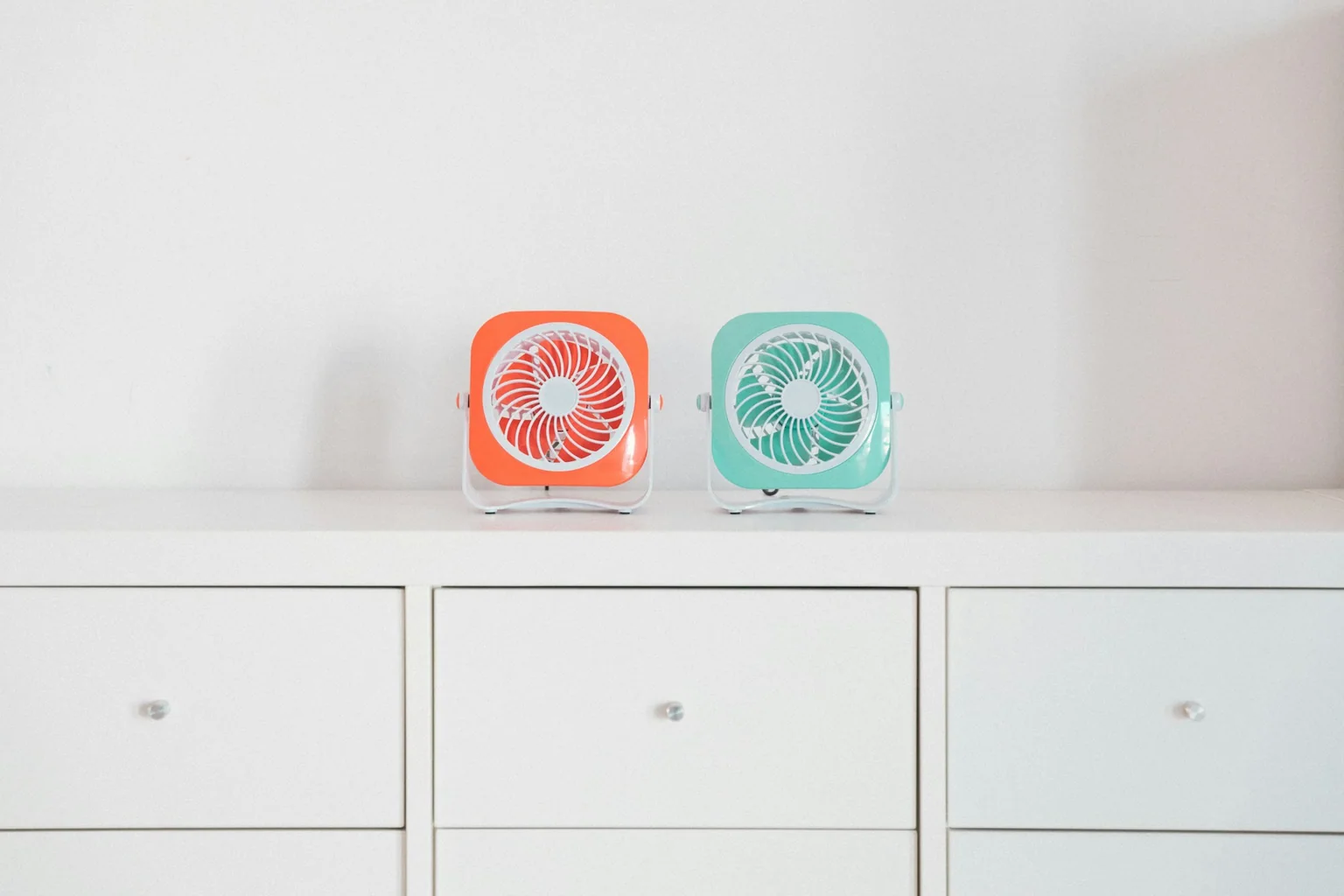
A tiny travel fan and a battery-platform jobsite fan are both portable, but they solve different problems. The useful distinctions are power source, mounting, packed size, airflow area and whether the unit remains stable around children, pets or crowded desks.
We reviewed current manufacturer documentation for four distinct formats. We did not measure airflow, sound or battery runtime, and manufacturer performance figures are identified rather than presented as independent test results.
Quick picks
| Product | Best for | Key feature | Price tier |
|---|---|---|---|
| Vornado FIT Personal Air CirculatorBest folding plug-in option | Suitcases, guest rooms and hotel desks with an outlet | Folds into a compact protected shape | Budget |
| Vornado Fly MoveBest rechargeable personal format | Short-term personal cooling away from outlets | Small rechargeable body designed for movement | Mid-range |
| RYOBI USB Lithium Clamp Fan Kit (FVF51K)Best clamp fan | Shelves, tents, strollers parked safely and work areas | Clamp opens to a listed 1.25 inches | Mid-range |
| RYOBI 18V ONE+ Hybrid Fan (PCL811B)Best larger flexible-power fan | Garages, outages and outdoor covered work areas | Runs from an 18V battery or extension cord | Mid-range |
Our researched picks
Best folding plug-in option
Vornado FIT Personal Air Circulator
The FIT is simple: two speeds, plug-in power and a folding format. It avoids battery aging and airline lithium rules, making it practical when an outlet is reliable at the destination.
Key specifications
- Two speed settings
- Folding design
- Plug-in power
- Three-year warranty listed
Pros
- No battery to charge
- Compact folded shape
- Straightforward controls
Cons
- Requires an outlet
- Limited placement without an extension
- Personal-scale airflow
Best rechargeable personal format
Vornado Fly Move
Vornado currently lists the Fly Move among its small circulators as a rechargeable, ultra-portable option. Its role is personal airflow, not cooling a room.
Key specifications
- Rechargeable portable format
- Personal-scale design
- Current product listed by Vornado
Pros
- No cord during use
- Small travel-oriented footprint
- Easy to reposition
Cons
- Battery runtime varies by speed and age
- Needs charging
- Not a room fan
Best clamp fan
RYOBI USB Lithium Clamp Fan Kit (FVF51K)
A clamp creates airflow where there is no clear tabletop. RYOBI lists two speeds, a pivoting head, 135 CFM and up to seven hours on low with the included 2Ah battery; those are manufacturer figures, not Ubestchoices measurements.
Key specifications
- Two speeds
- 1.25 in listed clamp capacity
- USB Lithium removable battery
- 135 CFM listed by manufacturer
Pros
- Flexible mounting
- Removable battery system
- Kit includes battery and charging cable
Cons
- Clamp needs a stable compatible edge
- Small airflow zone
- Runtime depends on setting and battery condition
Best larger flexible-power fan
RYOBI 18V ONE+ Hybrid Fan (PCL811B)
Hybrid power is useful when portability and long plugged-in sessions both matter. RYOBI lists three speeds and a 160-degree pivoting head. It is much larger than a personal travel fan but easier to reposition than a pedestal model.
Key specifications
- 18V ONE+ battery or corded operation
- Three speeds
- 160-degree pivoting head
- Tool-platform battery sold separately in some packages
Pros
- Two power-source choices
- Broader use than a mini fan
- Fits existing ONE+ batteries
Cons
- Too large for most carry-ons
- Battery may not be included
- Extension cord must be safely routed
How we evaluated
We compared four fan formats rather than forcing different sizes into one airflow ranking. Criteria included power source, portability, mounting, control simplicity, platform ownership and the physical area each format is intended to serve.
We did not measure CFM, noise or runtime. Those values can vary with distance, speed, battery and room conditions. Manufacturer numbers are useful for screening but not directly comparable unless test methods match.
Buying guide
Define portable
If it must fly in a carry-on, packed dimensions and battery rules dominate. If it moves between rooms, handle and power flexibility matter more.
Choose power before size
Plug-in fans avoid battery maintenance; rechargeable fans work away from outlets; tool-platform fans are best when compatible batteries already exist.
Plan the mounting surface
A clamp fan needs a strong edge; a tabletop fan needs a stable base; a floor fan needs clearance. Never balance a fan where vibration can move it.
Use airflow honestly
A fan moves air and may improve perceived comfort, but it does not lower room temperature like air conditioning. Extreme heat needs appropriate cooling and health precautions.
Check cleaning access
Dust reduces airflow and can increase noise. Look for safe grille access and follow instructions before disassembly.
FAQ
Can I take a rechargeable fan on a plane?
It depends on battery size, whether the battery is installed or spare, and airline rules. Check the watt-hour rating and the airline’s lithium-battery policy before packing.
Will a portable fan cool a bedroom?
A larger circulator can move room air, but a personal fan mainly affects the immediate area. Neither removes heat from the room.
Is a clamp fan safe for a stroller?
Only when the manufacturer permits the use and the fan is securely mounted out of the child’s reach, with no loose cord or access to the blades. Recheck it frequently.
Are more speed settings important?
Fine control can help balance airflow and sound, but stable mounting, suitable size and reliable power are usually more important than the number of buttons.
What we would prioritize
Pick the fan format that matches the place: Vornado FIT for outlet-based travel, Fly Move for personal rechargeable use, RYOBI’s clamp fan for constrained surfaces and the hybrid model for larger flexible-power jobs.
Sources and verification
Product availability was checked on . Manufacturer pages remain the final reference because specifications and compatibility can change.
- FAA PackSafe — Lithium batteries — Air-travel battery context for rechargeable fans.
- CDC heat and health guidance — Why fans are not a substitute for adequate cooling during dangerous heat.