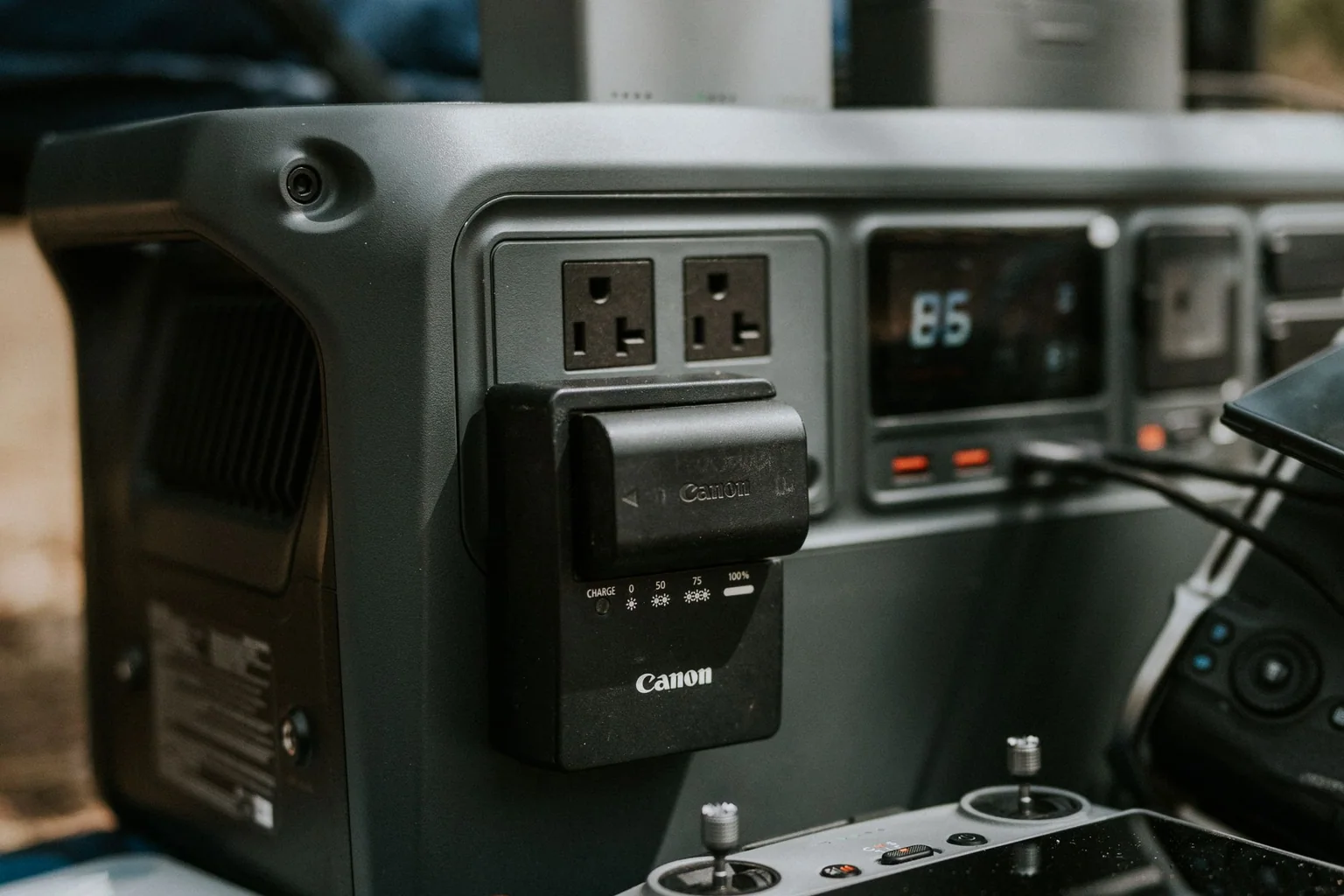
Portable power stations bundle a rechargeable battery, inverter and charging ports into one unit. They are useful for electronics, lights, communication equipment and carefully sized appliances, but they are not whole-home generators and their advertised watt-hours do not equal energy delivered at the outlet.
This guide is for buyers comparing roughly 677Wh to 1,024Wh lithium-iron-phosphate models. We evaluated current manufacturer documentation, output, port mix, weight, cycle-life claims, warranty and expansion options. We did not discharge-test these units, so runtime and cycle figures below remain manufacturer specifications.
Quick picks
| Product | Best for | Key feature | Price tier |
|---|---|---|---|
| EcoFlow DELTA 3 PlusBest balanced 1kWh option | Camping plus short home-backup duty | 1,024Wh capacity with 1,800W AC output | Premium |
| Anker SOLIX C1000 Gen 2Best for higher-output 1kWh needs | Buyers prioritizing inverter headroom | 2,000W rated output from a 1,024Wh LFP unit | Premium |
| BLUETTI AC70Best lighter mid-capacity pick | Car camping and moderate loads | 768Wh capacity at a listed 22.5 pounds | Mid-range |
| Goal Zero Yeti 700Best compact camp-focused pick | Lighting, charging and lower-wattage appliances | 677Wh LFP system at a listed 20.3 pounds | Premium |
Our researched picks
Best balanced 1kWh option
EcoFlow DELTA 3 Plus
The DELTA 3 Plus combines a familiar 1kWh capacity class with enough continuous output for many household essentials and a broad port selection. EcoFlow lists 13 outputs, LFP chemistry and a five-year warranty.
Key specifications
- 1,024Wh rated capacity
- 1,800W AC output
- 27.6 lb listed weight
- 4,000 cycles to 80 percent listed by manufacturer
Pros
- Useful balance of capacity and output
- Broad port selection
- Five-year warranty listed
Cons
- Too heavy for casual carry
- Premium tier
- App and expansion features may be unnecessary for simple loads
Best for higher-output 1kWh needs
Anker SOLIX C1000 Gen 2
Anker lists 2,000W continuous output, 3,000W peak output, 10 ports and up to 600W solar input. That combination suits buyers who know their appliances have higher starting or operating demands, while capacity remains in the portable 1kWh class.
Key specifications
- 1,024Wh rated capacity
- 2,000W output; 3,000W peak listed
- 10 output ports
- LFP battery; 4,000-cycle claim to 80 percent
Pros
- High output for its capacity class
- Strong solar-input specification
- Fast transfer specification for backup use
Cons
- High-output loads can empty 1kWh quickly
- Premium cost
- Runtime claims depend heavily on load
Best lighter mid-capacity pick
BLUETTI AC70
The AC70 trades some capacity and output for lower weight. BLUETTI lists 768Wh, 1,000W output and LFP chemistry, making it easier to move than the 1kWh options while retaining AC, DC and USB connectivity.
Key specifications
- 768Wh rated capacity
- 1,000W AC output
- 22.5 lb listed weight
- 3,000+ cycles to 80 percent listed
Pros
- More portable than many 1kWh units
- LFP battery chemistry
- Appropriate scale for electronics and moderate camp loads
Cons
- Less capacity for overnight backup
- 1,000W ceiling rules out some appliances
- Expansion increases total system complexity
Best compact camp-focused pick
Goal Zero Yeti 700
The Yeti 700 is the smallest unit in this comparison. Its 600W AC rating is modest, but the lower weight is valuable when power must move between a vehicle, campsite and home shelf.
Key specifications
- 677Wh rated capacity
- 600W AC output; 1,000W surge listed
- 20.3 lb listed weight
- Five-year warranty listed
Pros
- Lowest listed weight in this group
- Simple fit for low-to-moderate loads
- Long warranty on paper
Cons
- Lowest continuous output here
- Limited for high-draw cooking or heating
- Premium cost per watt-hour
How we evaluated
We compared models that were listed as current on their manufacturers’ sites on August 29, 2026. Criteria included rated watt-hours, continuous AC output, listed weight, LFP chemistry, port mix, warranty and whether the unit occupies a distinct use case.
We excluded invented runtime rankings. Actual delivered energy is reduced by inverter and conversion losses, temperature, battery age and load behavior. Cycle life, recharge time and surge figures are manufacturer claims unless independently certified documentation says otherwise.
Buying guide
Build a load table
Write down each device’s running watts, starting surge and hours of use. Add the watt-hours, then allow for conversion loss and a reserve. This is more reliable than shopping by household size.
Separate capacity from output
Watt-hours estimate how long energy may last; watts describe how much power can be delivered at once. A station can have enough energy but still be unable to start a demanding appliance.
Treat portability as a hard limit
A 20- to 28-pound unit is movable, but not effortless. Include cables, solar panels and expansion batteries in the real carry weight.
Check battery chemistry and warranty
All four picks use LFP chemistry, valued for long cycle-life claims and thermal stability. Compare the exact warranty term, exclusions and support process in your country.
Plan recharging before the outage
Wall, vehicle and solar inputs have different limits. Solar results depend on panel rating, angle, shade and weather, so a theoretical maximum is not a daily guarantee.
Use safe placement
Keep the unit dry, ventilated and within the manufacturer’s temperature range. Do not backfeed a home circuit or improvise electrical connections; use a qualified electrician for transfer equipment.
FAQ
How large a power station do I need for a refrigerator?
Check the refrigerator’s running and starting requirements, then measure or estimate daily energy use. A 1kWh unit may cover a short interruption for some efficient refrigerators, but there is no universal runtime.
Can a portable power station run a space heater?
Some inverters can supply the wattage, but resistance heaters consume energy very quickly and may exceed continuous ratings. Heating is usually a poor use of limited battery capacity.
Are solar recharge times reliable?
Treat them as best-case planning figures. Panel wattage, sun angle, temperature, clouds, cable loss and the station’s input curve all affect real recharge time.
Can I take a large power station on an airplane?
Typical units in this guide far exceed normal passenger spare-battery limits. Consult the airline and aviation regulator; do not assume checked baggage is permitted.
What we would prioritize
Choose a portable power station from a written load plan. The EcoFlow and Anker suit broader 1kWh duties, BLUETTI offers a lighter middle ground, and Goal Zero favors portability. None replaces electrical safety or a realistic energy budget.
Sources and verification
Product availability was checked on . Manufacturer pages remain the final reference because specifications and compatibility can change.
- FAA PackSafe — batteries and portable electronic devices — Passenger-air-travel battery restrictions.